
Agents your business can email.
They get on with the job. You decide what waits for your Approve — and as they prove themselves, less does.
Signing in is one field: we email you a code. No form, no password.
Pick an agent. Give it an address. It starts work.
One job each. The ones marked “Our crew” run our own company on the same platform — that is how we know they work.
The quoting agent
Estimating
Turns a customer's enquiry and drawings into a priced quote from your rate card.
Waits for you
Every quote before it is sent.
You can hire this one
£29/mo, first quote free
Get this agentSam
Sales
Finds the firms you want to work with, writes the first email and follows up. Every reply to a person waits for your Approve.
Waits for you
Every reply to a person.
Coming soon
Tell us you want it and we will let you know.
Register interestQuartermaster
Operations
Reports on what every agent did overnight, and what needs a person.
Waits for you
Nothing; it reports.
We run this ourselves
Ask us about it.
Ask us about itScribe
Writing
Send it a brief by email and it drafts the next newsletter edition.
Waits for you
Every edition before it goes out.
We run this ourselves
Ask us about it.
Ask us about itHerald
Mailing list
Runs our mailing list. When you subscribe, your address joins the short list of people it is allowed to write to.
Waits for you
Your subscription — double opt-in.
We run this ourselves
Ask us about it.
See it liveOne of them, doing a real job
A quote request landed with drawings attached. By the afternoon, a £51,061 quote for a single-storey rear extension was waiting for Approval.
A true story from a customer's inbox. Here is how it went.
9:14 — A QUOTE REQUEST ARRIVES
The enquiry
From:Jo Reeves <j.reeves@gmail.com>Subject:Rear extension quote — Jo ReevesHi — we're hoping to extend the back of the house: a single-storey rear extension with a kitchen-diner. I've attached the architect's drawings. Could you give us a price? Thanks, Joarchitect-drawings.pdfTHE AGENT WRITES BACK
It asks before it prices
From:Quotes — your firmTo:Jo ReevesSubject:Re: Rear extension quote — Jo ReevesThanks Jo — two things before we price this properly: 1. Is there side access for a skip and deliveries? 2. Is stripping out the existing kitchen in scope, or are you keeping it?From:Jo ReevesSubject:Re: Rear extension quote — Jo ReevesSide access is clear. The old kitchen is coming out — please include it.What the questions look like.
Your clients get a professional back-and-forth with your business — not a form, not a chatbot. The agent asks only what it actually needs.
PRICED FROM YOUR RATE CARD
Your numbers, not the internet's
Every line priced from your rate card — labour and materials, your margin, your contingency, your VAT. The arithmetic is done by the platform, not the AI — totals are computed, never imagined.
Subtotal£36,183.00Contingency & margin£6,368.21VAT (20%)£8,510.24Total£51,061.45IT WON'T GUESS
What it isn't sure of, it says so
A measurement read off the drawings, not taken with a tape, is flagged for you to confirm, never buried in a number. And anything with no match on your rate card is listed as not priced, for you to price or send back. Nothing the agent is unsure of becomes a quiet line item.
ONE SCREEN. BUTTONS.
You stay in charge
The three buttons under every draft.
Edit a line, send it back with a note, or press Approve & send. Jo's answers are already in the quote. Nothing goes to Jo until you press the button.
SAME DAY
A quotation your business is proud of
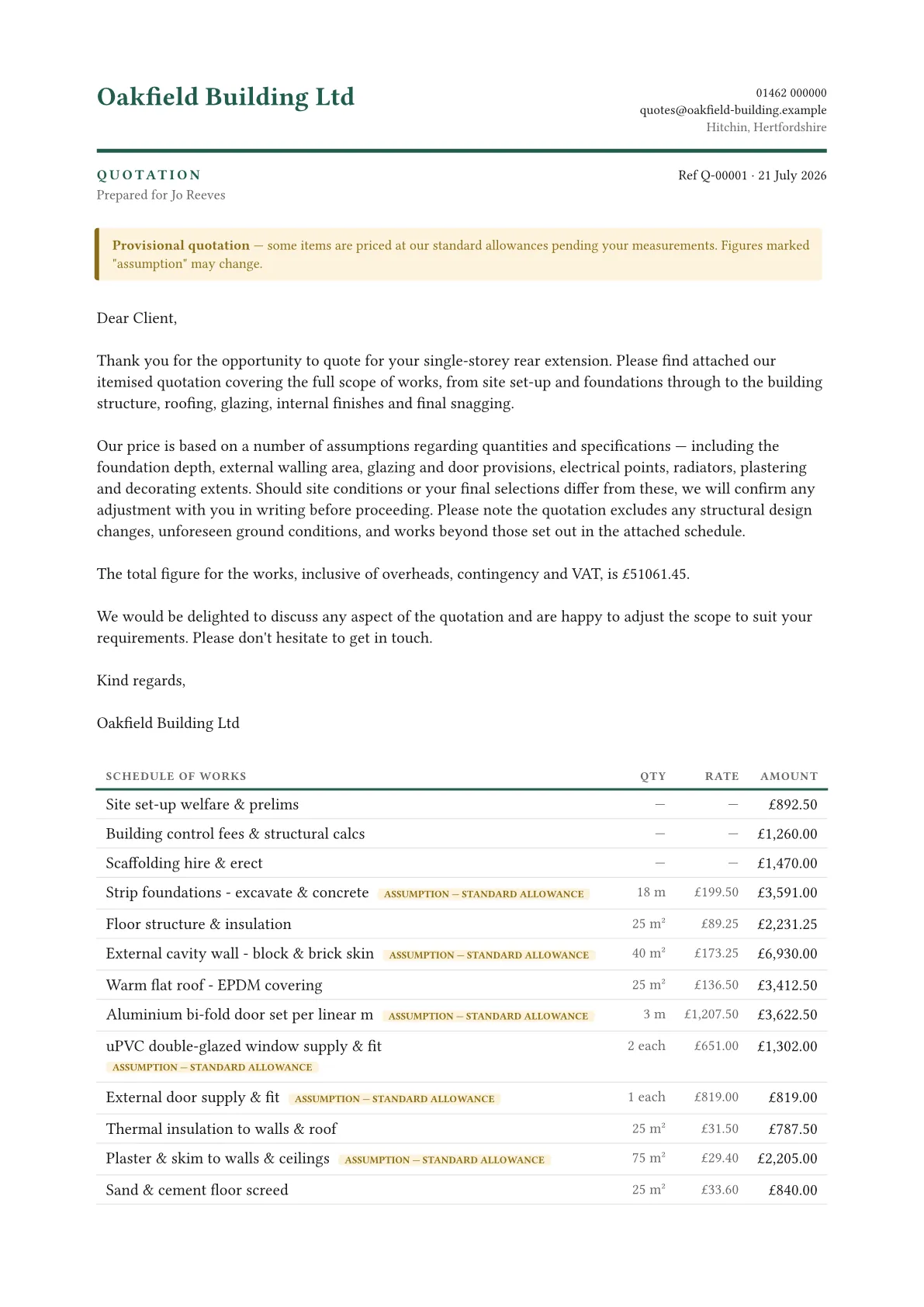
A branded, itemised quotation — assumptions and exclusions stated, your firm's name on it — in Jo's inbox while your competitors are still promising to call back.
Why email?
Everyone already has an address.
Your customers, your suppliers, you. No app to download, no portal to log into, nothing to explain.
An email says who sent it.
The people your agent deals with never sign up for anything. They write to it the way they would write to you.
Nothing to install.
The agent brings its buttons to your inbox. The few things that need your judgement arrive as a button to press.
Trust it earns
- A new agent starts supervised. Everything it wants to send waits for you.
- What it may do on its own is your decision. Loosen the reins as it earns them.
- It can only email people you have approved.
- Everything it sends is on record.
UK company. EU/UK data residency. Your data is never used to train models. The long version →
Building an agent? Start here →